


Male Factor Infertility: Causes, Testing, and Treatment
When a couple struggles to conceive, attention often falls first on the woman — but that's only half the picture, sometimes literally. A male factor plays a role in roughly half of couples who have difficulty getting pregnant, and is the primary cause in about a third of cases. The encouraging part: male factor infertility is common, it's straightforward to test for, and it's often treatable.
At Tennessee Fertility Institute (TFI), we evaluate male infertility every day, and we work with both partners as a team. This guide covers what male factor infertility is, what causes it, how it's diagnosed, and the treatment options that help many men go on to father healthy children.
What Is Male Factor Infertility?
"Male factor infertility" simply means that something related to sperm — how many there are, how well they move, their shape, or how they're delivered — is making conception more difficult. Infertility is generally defined as not conceiving after 12 months of regular, unprotected intercourse (or 6 months if the female partner is over 35). Because a male factor is involved so often, both partners should be evaluated from the start — testing the man is quick, non-invasive, and one of the most informative first steps a couple can take.
What Causes Male Factor Infertility?
Male fertility depends on producing enough healthy, well-moving sperm and being able to deliver them. Problems can arise at any point in that chain. Common causes fall into a few groups:
Sperm production issues
-
Varicocele — an enlargement of the veins draining the testicle, and the most common correctable cause of male infertility
-
Hormonal or endocrine imbalances affecting the signals that drive sperm production
-
Genetic or chromosomal conditions (such as Klinefelter syndrome or Y-chromosome changes)
-
Undescended testicles, prior infections, or certain medical treatments like chemotherapy and radiation
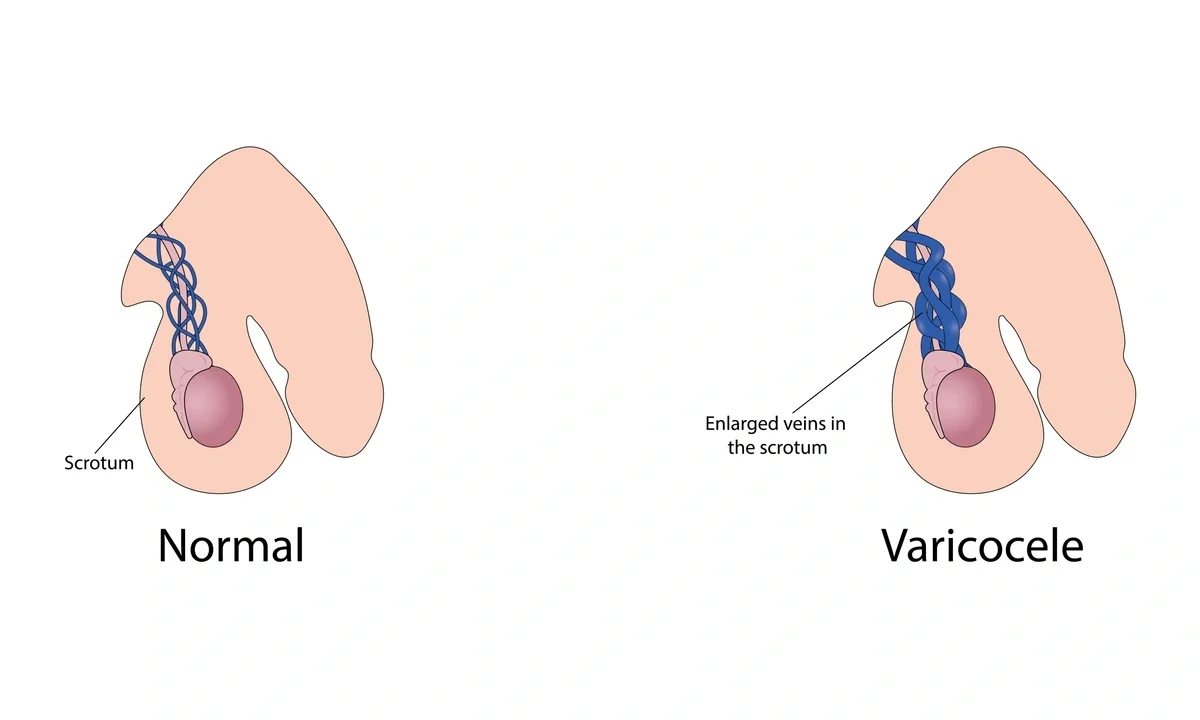
Depiction of varicocele
Sperm transport or delivery issues
-
Blockages or absence of the tubes that carry sperm
-
Retrograde ejaculation or erectile/ejaculatory difficulties
-
Prior vasectomy
Lifestyle and environmental factors
-
Heat exposure, some industrial chemicals, heavy metals, and radiation
-
Tobacco, heavy alcohol use, anabolic steroids, and recreational drugs
-
Obesity and, to a degree, advancing age — sperm quality declines gradually with age, too
In many men, the cause is treatable or reversible. And in a meaningful share of cases (roughly 15–30%), no clear cause is found — what's called idiopathic infertility — which doesn't mean pregnancy isn't achievable.
How Is Male Factor Infertility Diagnosed?
Evaluation usually starts with a medical history, a physical exam, and the cornerstone test: a semen analysis, which measures several distinct sperm characteristics. Depending on the results, your physician may add hormone bloodwork, genetic testing, or a scrotal ultrasound.
The World Health Organization publishes reference values for semen analysis, updated in its 6th edition (2021). The current lower reference limits are:
-
Semen volume: 1.4 mL or more
-
Sperm concentration: 16 million per mL or more
-
Total sperm number: 39 million per ejaculate or more
-
Total motility: 42% or more (the share of sperm that are moving at all)
-
Progressive motility: 30% or more (the share moving forward purposefully)
-
Normal morphology: 4% or more (the share with a typical shape)
Two things are worth understanding about these numbers. First, total motility and progressive motility are not the same — total motility counts every moving sperm, while progressive motility counts only those swimming forward effectively, so they're reported as two separate figures. Second, these limits are a statistical benchmark, drawn from the lowest 5% of men who fathered a child naturally — not a pass/fail line. A single result below a reference value is not a diagnosis of infertility; because sperm counts naturally fluctuate, a repeat analysis is usually recommended before drawing conclusions.
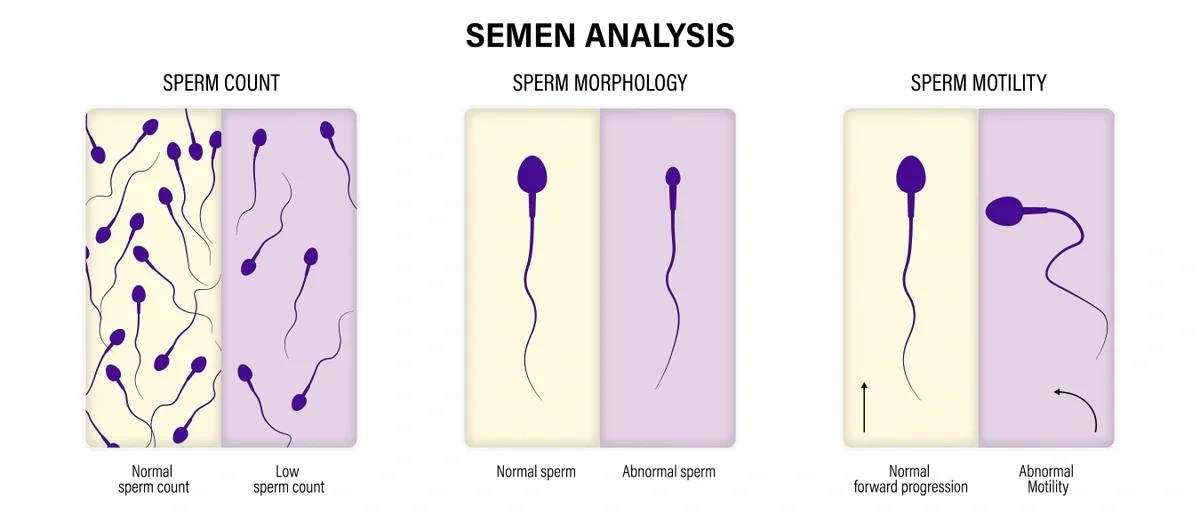
Illustration of semen analysis parameters
Can Male Factor Infertility Be Treated?
In most cases, yes — and the right approach depends on the cause:
-
Lifestyle changes. Addressing modifiable factors — weight, smoking, alcohol, heat exposure, and certain medications — can improve sperm quality over a few months (sperm take roughly 2–3 months to develop). Some men also ask about supplements; the evidence is mixed, so it's worth discussing with your physician.
-
Treating an underlying cause. A varicocele can often be corrected surgically, hormonal imbalances can be treated medically, and some blockages are reparable.
-
Assisted reproduction. When treatment alone isn't enough, IUI or IVF can help. For significant male factor, ICSI — injecting a single sperm directly into each egg — is especially effective. Our guide on when IVF or ICSI is recommended for male factor goes deeper.
-
Surgical sperm retrieval. When little or no sperm is present in the ejaculate, sperm can often still be retrieved directly and used with IVF/ICSI.
-
Donor sperm. Donor sperm is a positive path to parenthood for some individuals and couples, including when other options aren't successful.
If you're facing treatment that could affect fertility — such as chemotherapy — sperm freezing beforehand preserves your options. TFI also partners with trusted reproductive urologists for the treatment of male infertility.
When Should You See a Specialist?
Consider a fertility evaluation after 12 months of trying (or 6 months if the female partner is over 35), or sooner if there's a known risk factor — a history of undescended testicles, prior chemotherapy, testicular injury or surgery, or difficulty with erections or ejaculation. Because male factor is so common and so easily tested, there's no reason to wait and no reason for the evaluation to fall only on your partner.
Frequently Asked Questions
How common is male infertility? Very. A male factor contributes to roughly half of all cases of infertility and is the primary cause in about a third. That's why fertility specialists recommend evaluating both partners from the beginning.
What does a semen analysis measure? It looks at semen volume, sperm concentration, total sperm number, motility (both total and progressive), morphology (shape), and vitality. Together these help show whether a male factor may be contributing. A single below-range result isn't a diagnosis — a repeat test is usually advised.
Is male infertility treatable? Often, yes. Many causes — like varicocele, hormonal imbalances, and lifestyle factors — are treatable or reversible, and assisted reproduction (especially IVF with ICSI) helps in many cases where sperm quality is low.
Can lifestyle changes improve sperm quality? They can. Because sperm take about 2–3 months to develop, improvements to weight, smoking, alcohol, and heat exposure may show up in a semen analysis a few months later. Your physician can advise what's most likely to help in your situation.
Does age affect male fertility? Yes, though more gradually than for women. Sperm quality and quantity slowly decline with age, which can lengthen the time to conception and modestly affect outcomes.
The Bottom Line
A male factor diagnosis is common, and for most men it's far from the end of the road — it's the start of a plan. Testing is simple, many causes are treatable, and today's assisted reproductive options are highly effective for male factor infertility. The most important step is getting evaluated, together with your partner.
If you'd like to understand what's affecting your fertility and what your options are, request a consultation to get started at our Nashville or Franklin location.