


When IVF or ICSI Is Recommended Due to Male Factor Infertility
When fertility testing points to a male factor, it can be both unexpected and emotionally complicated. Many people don’t anticipate sperm parameters being the primary reason treatment recommendations shift to IVF or ICSI—and seeing numbers on a semen analysis report without clear context can raise more questions than answers.
It’s important to say this clearly: male factor infertility is common and very treatable. When IVF or ICSI is recommended, the goal isn’t escalation for its own sake—it’s choosing the approach most likely to lead to fertilization and pregnancy.
Below, we explain how semen analysis results guide these recommendations, using real‑world reference ranges and examples along the way.
First, a note about semen analysis results
Semen analysis reflects a snapshot in time. Results can vary based on:
-
Illness or fever
-
Stress
-
Time between ejaculations
-
Collection technique
Because of this, fertility specialists look for patterns, often over more than one test, rather than reacting to a single value in isolation. You can learn more about this test here.
When IVF may be recommended due primarily to male factor
IVF becomes a consideration when semen analysis results suggest that fertilization is unlikely to happen reliably with timed intercourse or IUI alone.
For example, IVF may be recommended when:
-
Sperm concentration is consistently below ~15 million sperm per milliliter, which is the commonly referenced lower end of the expected range
-
Overall sperm movement is reduced, even if some sperm are present
-
Prior IUIs have been unsuccessful despite adequate timing and ovulation
IVF allows fertilization to occur in a controlled lab environment, increasing the number of eggs exposed to sperm at one time—rather than relying on a narrow natural window.
When ICSI is commonly recommended (and why)
ICSI (intracytoplasmic sperm injection) is a specialized form of IVF where a single sperm is injected directly into an egg. It is most often recommended when male factor infertility is the primary limiting factor for fertilization.
Rather than relying on sperm to reach and penetrate the egg on their own, ICSI bypasses several biological hurdles.

Image depicting ICSI procedure
Below are the most common scenarios where ICSI becomes the preferred approach.
When sperm count is significantly low
Sperm concentration normally falls at or above ~15 million sperm per milliliter. When counts are well below that threshold, fertilization can become unpredictable.
In practice:
-
Mild reductions may still allow for conventional IVF
-
When total motile sperm counts fall below ~5 million, IVF with ICSI is often recommended to avoid failed fertilization
ICSI allows fertilization to proceed even when only limited sperm are available.
When total motile sperm count is very low
Total motile sperm count (TMSC) combines volume, concentration, and movement into one number—and is one of the most clinically useful measures.
As a general guide:
-
Above ~20 million total motile sperm may be compatible with unassisted conception
-
5–20 million often prompts assisted treatment like IUI or IVF
-
Below ~5 million frequently leads to a recommendation for IVF with ICSI
At very low TMSC levels, relying on sperm to reach and fertilize an egg—naturally or even in standard IVF—becomes less reliable.
When motility is poor
Motility refers to the percentage of sperm that are moving. A commonly referenced lower limit is ~40% motile sperm, with ~32% showing forward (progressive) movement.
When motility falls well below those levels:
-
Sperm may struggle to reach the egg
-
Fertilization rates may be lower with standard IVF
In these cases, ICSI improves reliability by selecting a motile sperm and placing it directly into the egg.
When sperm morphology is low
Sperm morphology evaluates shape. It often surprises patients to learn that a normal reference range starts at ~4% normally shaped sperm.
When morphology is:
-
Consistently below 4%, especially alongside low count or motility
-
Associated with prior fertilization issues
ICSI may be recommended to help overcome barriers related to egg penetration.
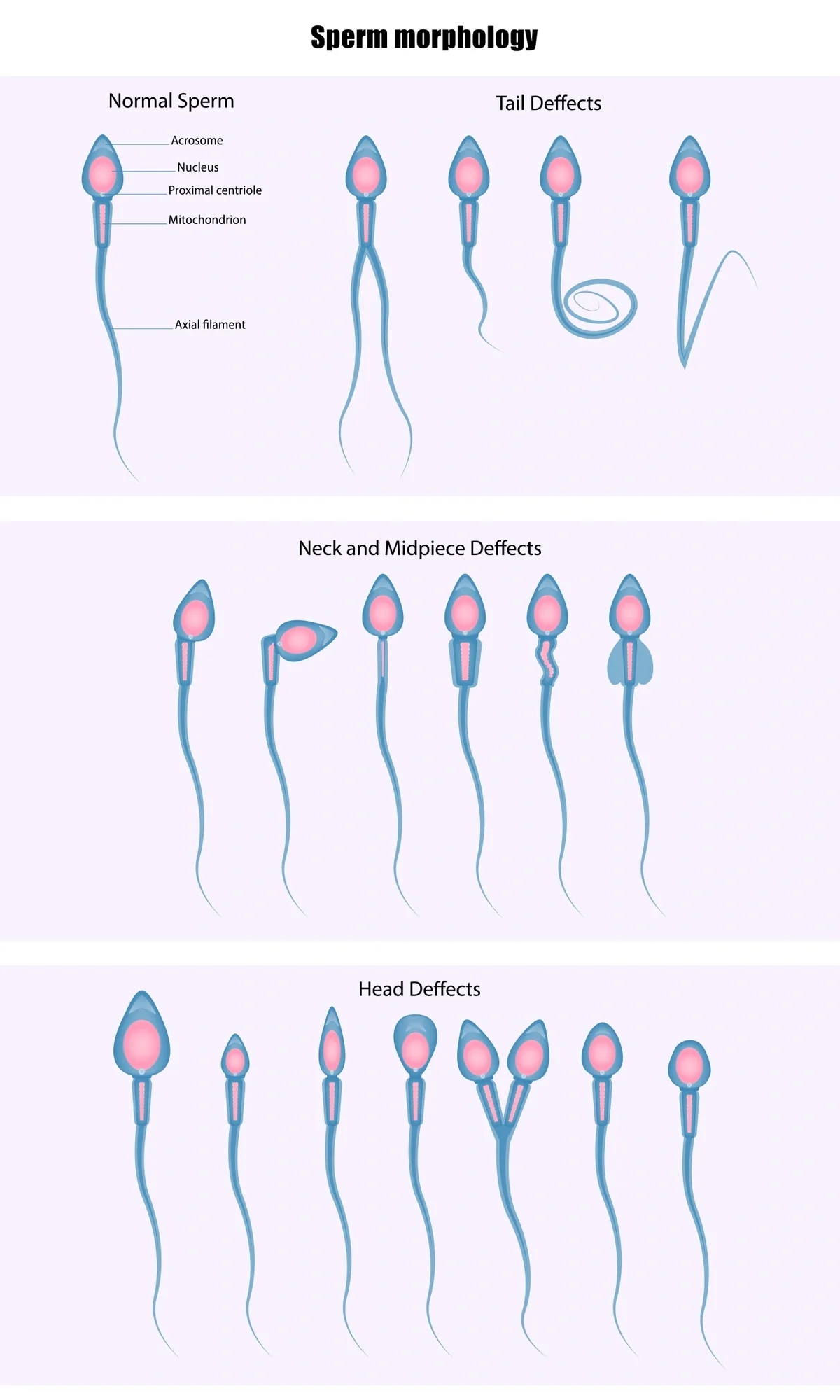
Image depicting sperm morphology
When fertilization was poor or absent in a prior IVF cycle
Sometimes semen analysis results are borderline, yet fertilization during IVF is unexpectedly low—or doesn’t occur at all.
In these situations, ICSI may be recommended in future cycles regardless of whether numbers technically meet reference ranges. Past fertilization performance often carries more weight than a single lab value.
When sperm are obtained through surgical retrieval
If sperm are retrieved directly from the testicle or epididymis, they generally cannot fertilize an egg on their own. In these cases, ICSI is almost always required, regardless of quantity.
Does male factor infertility affect pregnancy after fertilization?
In most cases, it does not.
Once an embryo is created:
-
Male factor infertility typically does not impact implantation
-
Pregnancy outcomes are often comparable to non–male‑factor IVF
The main challenge is achieving fertilization. IVF with ICSI is designed to address that specific step.
Addressing stigma, guilt, and emotional weight
Male factor infertility can carry unnecessary emotional burden. Many individuals feel pressure when treatment recommendations escalate because of semen analysis results.
It’s important to remember:
-
Male factor infertility is biological—not personal
-
It affects a significant portion of couples seeking care
-
Modern fertility treatment offers highly effective solutions
ICSI exists because science recognizes and accommodates sperm variability—not because something has failed.
A reassuring takeaway
When IVF or ICSI is recommended primarily due to male factor infertility, it reflects thoughtful, individualized care—not a one‑size‑fits‑all approach.
By integrating semen analysis patterns, reference ranges, and prior outcomes, your care team is choosing the path most likely to:
-
Achieve fertilization
-
Use available eggs effectively
-
Reduce uncertainty
Understanding why these recommendations are made can make the next steps feel more grounded and manageable.
If you’re navigating male factor fertility results—or trying to understand whether IVF or ICSI makes sense for your situation—a consultation with a fertility specialist can help put the numbers into context and clarify next steps. Schedule yours with Tennessee Fertility Institute today!